UK and US Workplace Harassment Laws are Moving in Opposite Directions

Both the US and the UK have taken significant steps regarding employment law changes in 2026. The rules are complicated, yes, but more interestingly, they are moving in completely opposite directions.
While the UK is raising the bar on employer accountability for workplace harassment, the US is dismantling the federal framework that defined it. If your organisation operates in either of these jurisdictions, or like many companies in both, you need to understand what each shift means and how it will affect your business.
What are the UK Employment Law Changes in 2026
The UK direction is clear: prevention. Employers now have a legal duty to prevent harassment, not merely respond to it.
Since October 2024, employers have been required to take reasonable steps to prevent sexual harassment at work under the Worker Protection (Amendment of Equality Act 2010) Act 2023. From October 2026, that duty levels up significantly. Employers must now demonstrate they take all reasonable steps, setting the bar much higher by requiring them to show they have anticipated risks, assessed them, and taken practical preventive action before any incident occurs.
Two further employment law changes under the Employment Rights Act 2025 sharpen this picture.
April 2026 on whistleblowing
Workers who report sexual harassment automatically gain whistleblower protection, meaning NDAs can no longer be used to silence people on harassment claims.
And October 2026 on liability for third-party harassment
Employers will be directly liable if a third party, such as a customer, client, patient or contractor, harasses their worker where the employer failed to take preventive steps.
What Does "All Reasonable Steps" Actually Mean
The UK did not leave the definition entirely clear, but the Equality and Human Rights Commission has set out an eight-step guide that employment tribunals will most likely treat as a baseline.
Develop an effective anti-harassment policy that is clear for both employees and third parties
Engage your staff, making sure they are aware of the policy, available support, and consequences
Assess and take steps to reduce risk in your workplace, such as addressing power imbalances or expectations around after-work events
Create clear and accessible reporting mechanisms in the event of sexual harassment in the workplace
Train all employees on what sexual harassment looks like and what to do if it happens to or around them, reviewing the effectiveness of training and offering refresher sessions at regular intervals
Act promptly to resolve complaints while respecting the confidentiality of all parties and protecting the complainant
Take steps to prevent harassment from third parties
Regularly monitor and evaluate the effectiveness of your prevention measures
Essentially, employers will need to show they have conducted risk assessments, maintained accessible reporting lines, and delivered regular, quality-assured training. Having a policy that exists only on paper will no longer be enough.
Where Are the UK Employment Law Changes Heading
Tribunals will scrutinise implementation, not just intent. How often is training delivered? Does it change behaviour? Are reporting mechanisms actually used? The question is shifting from "do we have a policy?" to "does our policy work?”
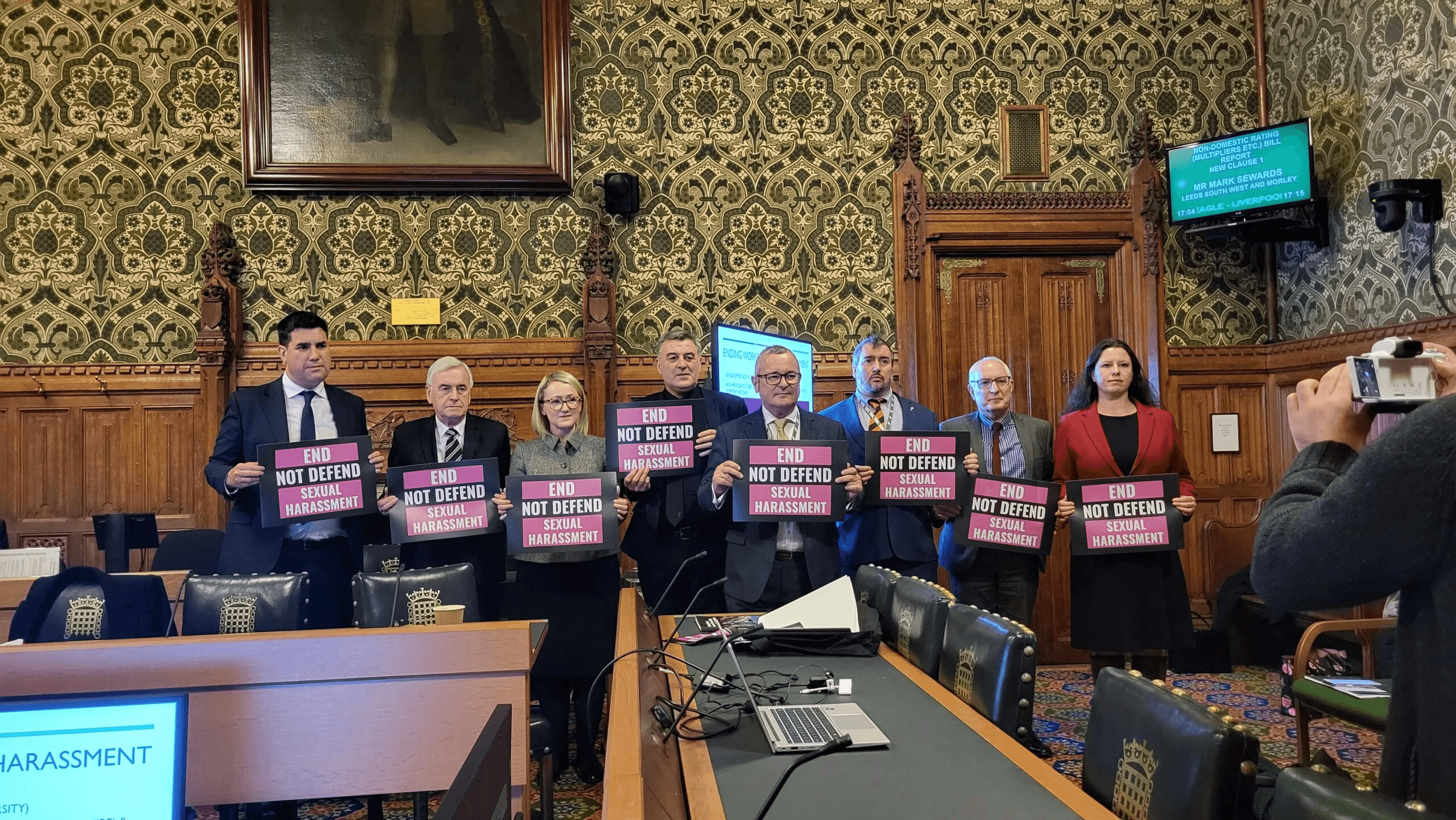
And there are further steps being pushed for. The End Not Defend initiative is campaigning to reclassify workplace sexual harassment as a reportable harm under health and safety regulations. Currently, sexual harassment at work is treated as an employee dispute, meaning it is the individual's problem to deal with. You have to tell HR or take your employer to tribunal. The burden is on you, and if you do not raise the issue, nothing happens.
If this succeeds, the enforcement infrastructure changes entirely. Harassment would be treated as a physical safety risk, in the same way as a broken fire escape or a dangerous piece of machinery. Just as employers do not wait for someone to get hurt before fixing a fire hazard, they would be legally required to identify the risk before anything happens. The burden would sit with the employer, and inspectors could hold them accountable whether or not anyone had ever complained.
What Is Happening to Employment Law in the US
The US is heading in almost the opposite direction.
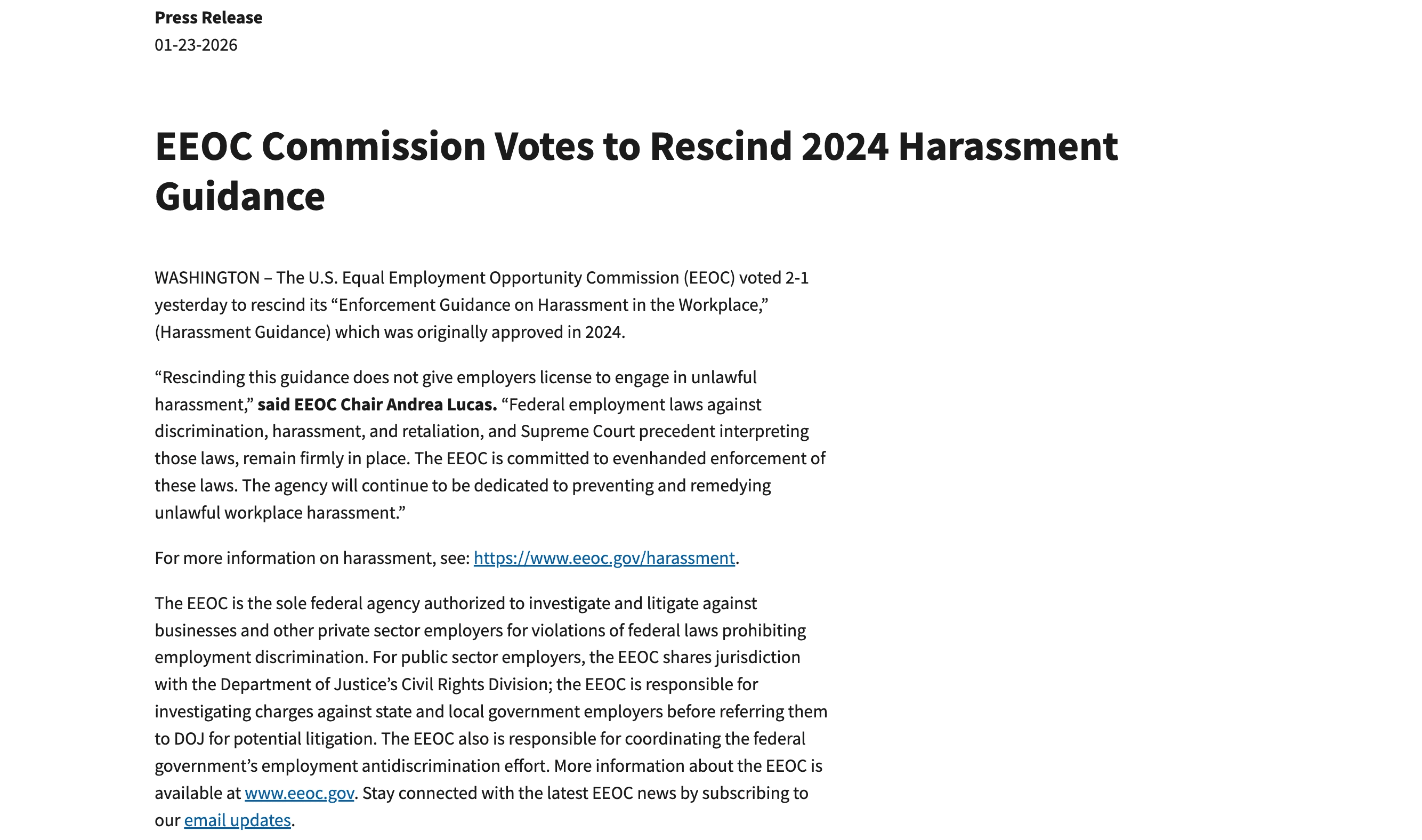
In January 2026, the Equal Employment Opportunity Commission (EEOC), the US federal body responsible for enforcing workplace discrimination and harassment law, voted to rescind its 2024 Enforcement Guidance on Harassment in the Workplace. In 2024, the EEOC had established a detailed framework under Title VII of the Civil Rights Act of 1964 telling employers what constituted illegal harassment under federal law, including protections based on gender identity and sexual orientation.
This rescission did not pass through Congress or any public debate. Three people voted, two said yes and one said no, without any consultation period or public notice.
What "Rescission" Does and Does Not Mean
The rescission does not change US law itself. Title VII of the Civil Rights Act still stands. It is a law passed by Congress and can only be changed by Congress. The EEOC has also stated it will continue to enforce harassment claims.
But removing the interpretation of how the law applies to gender identity and sexual orientation takes away the rulebook that told employers how to apply it. Without clear federal guidance on where the line is, that area becomes much murkier. Employers face more ambiguity and employees face a harder path when bringing claims.
For US employers in states including California, New York and Illinois, state-level protections remain in place and have not changed. The federal rollback does not override those. But for employers in states without equivalent protections, the practical effect is significant.
Where Is US Employment Law Heading
The short answer is: probably not changing any time soon.
The EEOC chair whose vote drove the rescission, Andrea Lucas, was confirmed by the Senate in July 2025 for a term that runs until 2030. That is two years beyond the end of the current presidential administration, meaning even if the political landscape shifts in 2028, the agency's leadership and direction are structurally locked in for the near future.
There has been legislative pushback. Following the rescission, federal lawmakers introduced the BE HEARD in the Workplace Act, a bill that would amend Title VII to explicitly write sexual orientation and gender identity into the statute itself, meaning protections could not be removed by an agency vote. But with the current Senate composition, that legislation has no realistic path to becoming law in this term.
For US employers, the practical implication is that federal ambiguity around harassment definitions is the baseline they are operating in for at least the next four years. State-level protections in California, New York, Illinois and others remain, but the federal safety net that once sat beneath them is significantly thinner than it was in 2024.
The Structural Difference that Really Matters in terms of Employment Law Compliance
The political contrast is evident. But the more consequential difference is structural. Organisations will need to plan much more carefully now, particularly those navigating both countries' legislation at the same time.
In the UK, these employment law changes are coming through legislation: the Employment Rights Act, Parliament, the statute book. They are durable. They do not reverse when a government changes, and a future administration would have to actively repeal them to undo them.
In the US, the rollback happened through an agency vote. Agency leadership typically serves at the pleasure of the executive, which means the current direction is less stable as a foundation for long-term compliance planning. What one administration can do through an agency, another can undo. But there is an important nuance: the end of this administration does not automatically mean the end of the current agency's direction, as the EEOC chair's term extends beyond 2028.
For organisations operating across both jurisdictions, this creates a genuine strategic choice. The instinct might be to align to whichever standard is lower in each market. The smarter position is the opposite. The direction of legal travel in the UK, and increasingly across Europe, is toward higher employer accountability and stronger worker protections. Building your culture and training around the more demanding standard is both the right thing to do and, increasingly, the lower-risk long-term position.
Where Are General Employment Law Changes Heading
UK employment tribunals will increasingly scrutinise not just whether training happened, but whether it demonstrably changed behaviour. The question of third-party liability will push employers to think about harassment risk far beyond their own workforce.
In the US, state-level protections are likely to diverge further from federal ones, creating a patchwork compliance landscape for multi-state employers. Human Rights Watch has documented the broader downstream effects of the current federal direction on gender equality protections—effects that are already being felt in how organisations approach DEI programmes and harassment reporting.
The underlying reality in both countries has not changed: workplace harassment is common, largely underreported, and significantly preventable with the right culture and training infrastructure.
What Should I Do for My Business to Keep Compliant
The employment law changes of 2026 present organisations with a clear choice: do the minimum the law requires in each jurisdiction, or build a consistent standard that reflects where law is heading rather than where it currently sits.
Arti helps organisations prepare for these exact moments through adaptive, research-backed training on sexual harassment, and workplace conduct. The best part? With it’s conversational-AI training, it readapts consistently, providing a continuous assurance that your business meets and exceed the standards the UK embeds in its law. If you want to see how it works in practice, book a demo.